Many years ago I tore my hamstring. It was the most painful thing I have ever done and even now I can still remember the feeling! I never knew quite why it tore but I know that it was most probably down to an imbalance or over use. Over the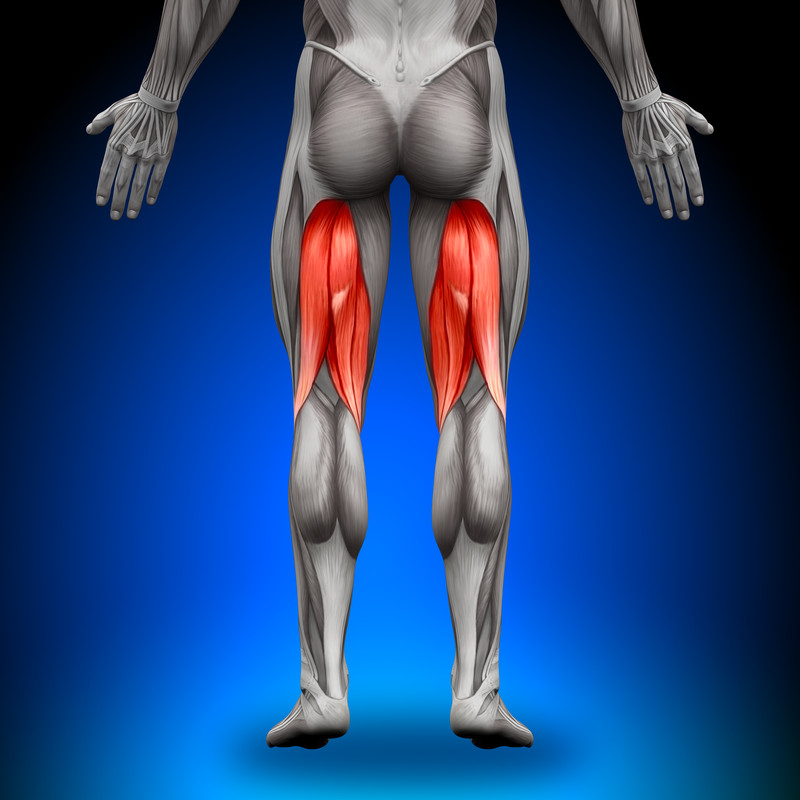 past few months it has come to my attention that a few clients are experiencing quadriceps overload and their hamstrings are quite weak. This made me think about investigating why this is happening and what you can do about it.
Hamstring injuries are commonly seen from exercise such as: sprinting, running or even kicking a ball. There is research that 80 % of injuries come from sprinting or running. When kicking a ball it is not the kick that damages the hamstrings but the actual stretch and eccentric contraction of the muscle prior to the kick. Sports that are faster, the tear occurs at the muscle belly near the insertion and the slower sports the tendon nearer the insertion. (If you are unsure where this is, take a look at the picture and where the muscle branches off into the knee is the insertion area). 97 % of injuries occur at the distal area (which is nearer the knee) and 45 % proximal (which is away from the knee). (science direct)
Reasons why:
Previous injuries/Flexibility and Exercise:
There are studies that say if you strength train your hamstrings for a particular sport you are less likely to get an injury than if you didn’t. If you are someone that has had a previous injury, you are would need to ensure strengthening of that hamstring as there has been a weakness developed and therefore again you could be liable to pick up an injury. However if you have sufficient rehabilitation afterwards this is fine. Flexibility is important too. If the hamstring is not flexible they may be slightly shorten and therefore cause injury. Too much work on the hamstrings as in fatigue is also going to bring on injury by increasing too much knee flexion. Exercises such as good mornings or deadlifts can also be dangerous to the hamstrings especially at the initial stage of the movement, if done too quickly.
Male versus female
Researching today I found out that both male and female have different contraction of muscles during certain exercises. An article gave information regarding a single leg squat and what muscles engage for both men and women. Apparently when a male performs the exercise he is more dominant in his hamstrings and when a female performs the exercise she mainly overloads her quadriceps and doesn’t engage the hamstrings!! Very interesting fact here! (pub med) This is because the length of the hamstring for women is shorter, compared to male, so this also indicates that females are more prone to hamstring problems.
What can you do about it?
It seems that the main key here is flexibility. Keeping your hamstrings a nice length with a good stretching program will help. Strengthening exercises choose wisely, as above if you are a female and looking to strengthen your hamstrings, single leg squat is not the way to go! If you go spinning or ride your bike, invest in a pair of cleats for your cycling shoes, they even out the load when you push and pull the pedals, therefore involving the hamstrings as equally with the quadriceps. With all this information, if in doubt ask. By seeking advice whether by myself or another professional you can see whether your hamstrings are weak or short and this will save you a lot of time before injury strikes!
Ref:
Liu, H, Williams, E. et al. (2012). ‘Injury rate, mechanism, and risk factors of hamstring strain injuries in sports: A review of the literature’. Available at: www.science.direct.com. (Accessed: 21st November 2016).
Wan, x. Qu, Fen, et al(2015). ‘Relationships amongst hamstring muscle optimal length and hamstring flexibility and strength’Science Direct. Available at: http://ac.els-cdn.com/S209525461630014X/1-s2.0-S209525461630014X-main.pdf?_tid=1a7e4772-b01f-11e6-bae4-00000aacb35d&acdnat=1479756011_833d92a46fa0db5be1a905a7092cbe42 (Accessed: 21st November 2016).
Youdas, J. Hallman, J et al (2007) ‘COMPARISON OF HAMSTRING AND QUADRICEPS FEMORIS ELECTROMYOGRAPHIC ACTIVITY BETWEEN MEN AND WOMEN DURING A SINGLE-LIMB SQUAT ON BOTH A STABLE AND LABILE SURFACE.’. Available at : http://journals.lww.com/nsca-jscr/Abstract/2007/02000/COMPARISON_OF_HAMSTRING_AND_QUADRICEPS_FEMORIS.20.aspx. (Accessed: 21st November 2016)