Pre exercise
It’s important to feed your body efficiently before exercise to get the most out of your session. As we get most of our energy from carbohydrates, these should be included before exercise to give our muscles the glucose they need to perform best. What you eat before exercise may depend on when you are exercising. If you are heading out early then eating breakfast first may not be an option but try one of the snacks below if you’re doing something demanding. These are quick and easy to make for any time before exercise.
Chocolate and banana chia pot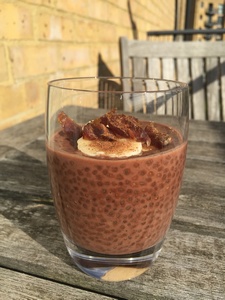
You can make this the day before and leave in the fridge. This makes a small snack for one but just scale up the quantities if you’re making it for more than one person or for breakfast. I use a jam jar with a lid to make it fuss free and easy to chuck in your bag!
- 5 tbsp milk – any of the unsweetened nut milks are fine or cow’s milk
- 2 tsp chia seed
- ½ tsp 100% cocoa powder
- ½ tsp honey
- ½ banana
- Optional: 1 chopped date, ¼ tsp cinnamon
Put all the ingredients in the jam jar apart from the banana. Put the lid on and shake until they are all combined. Leave for 10 mins, then shake again before putting it in the fridge. That’s it! Just add your banana to it just before eating.
Pear and cinnamon soaked oats 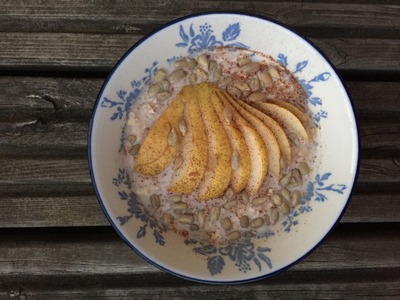
Another good one as a snack or a larger portion as breakfast. Again this is very convenient for making the day before and taking with you and I also make this in a jam jar. This is for one as a snack, scale appropriately.
- 2 tbsp rolled oats
- 6 tbsp milk – any of the unsweetened nut milks are fine or cow’s milk. Coconut is my favourite!
- Half a ripe pear
- 1 tsp sunflower seeds
- ¼ tsp cinnamon
Put all the ingredients in the jam jar apart from the pear and sunflower seeds. Put the lid on and shake. Leave for 10 mins, then shake again before putting it in the fridge. That’s it! Just add your pear and seeds to it just before eating.
A couple of oatcakes with nut butter is another good snack. There are many different nut butters available now – almond, pumpkin seed, brazil and macadamia are just a few of them and are usually available in supermarkets and health food shops next to the peanut butter.
Recovery
When we exercise the muscle fibre gets damaged. The body uses amino acids for many functions including repairing these damaged tissues and ultimately strengthening and enlarging the muscle.
Amino acids are what makes up proteins so it is essential we have enough protein in our diets. However it is important not to go overboard. As I have mentioned before, quality and quantity is key. It is generally advised that no additional protein is needed if you are exercising and the UK RDA of 0.8g/kg of body weight a day should be adequate for muscle repair.
This would mean if you weigh 65kg or 10st 3lb then you would need 52 grams of protein a day. This would need to be spread out across all meals but slightly higher proportion of it may be beneficial after exercise.
This is all very well, but what does 52 grams of protein look like? Well here are some food protein contents to help give you an idea:
| 1 egg
|
6 grams |
| 1 average chicken breast (no skin) 120g
|
37 grams |
| Can of tuna in water
|
33 grams |
| ½ cup Kidney beans (canned) | 8 grams |
| Tempeh 100g | 19 grams |
| Salmon 100g | 20 grams |
| 1 cup Broccoli chopped | 2.6 grams |
| 1 avocado | 4 grams |
Is all protein made equal? Well, not quite! Nearly all whole foods – meaning anything you can eat that hasn’t had anything done to it – contain protein. Animal protein sources are generally considered complete proteins, meaning they contain suitable levels of all the essential amino acids in one go for the human body to survive. Protein from plant sources may be lower in one or another of the essential amino acids and so it is better if a variety are combined together to make sure all essential amino acids are covered in sufficient levels.
Too much protein can have a negative effect on health, compromising bone health and causing dehydration. When we break down proteins, the liver and kidneys are involved in removing the waste products out of the body, if there is an increased amount of protein then these organs are under more stress. Let’s also not forget that protein is still an energy source so any excess will be stored as fat.
Water
Hydration is very important for exercise as well as everyday health. Performance can be inhibited, your body temperature can rise quicker and your heart has to work harder if you are not properly hydrated. A good way to check if you’re getting enough water throughout the day is to check the colour of your wee! It should be a pale yellow, not dark! Its best to avoid guzzling water in one go and instead sip it throughout the day. If you stay hydrated throughout the day, you’ll be ready for exercise at any time. If you are doing a strenuous workout, aim for 200ml every 20 mins of exercise and if you are sweating a lot, it may be worth investing in an electrolyte solution to add to your water such as Elete
Other helpful tips
Epsom salt baths (magnesium sulphate) can help to unwind the feeling of tight muscles after strenuous exercise. Run a hot bath and throw a handful or two of the salts and relax for 20 minutes. Also, there is some evidence to suggest this raises magnesium levels in the body so if you struggle to get enough magnesium in the diet, this could help you out and it’s great for making skin soft.
Did you know
If you are breast feeding, exercise can increase levels of lactic acid in breast milk for up to 30 minutes after exercise. This may effect the taste of breast milk shortly after activity. You may find your baby prefers the taste before you exercise!